
The Right to Bear (bare) Feet.

I’ve used Halifax’s Access-a-Bus Service fairly consistently both for social and professional reasons for about the last 12 years (give or take a short period of full time work from home in the high COVID era).
For those unaware, Access-a-Bus is an offshoot service under the umbrella of Halifax Transit, so, city buses. AAB offers service for seniors and those with disabilities who are primarily unable to use conventional transit for a myriad of reasons. Each individual’s reasons are deeply personal, but some could include inability to walk to/wait at a transit stop, use of specialized mobility or medical equipment, fall risk, anxiety, intellectual disability, temporary incapacity, and more.
Unlike conventional transit, Access-a-Bus will meet a client at their pickup location, and drop them off directly at their destination.
While not without a number of flaws within its current operating system, largely I am grateful that such a service exists in Halifax Regional Municipality.
While it is true that the constraints of Access-a-Bus mean:
-It’s next to impossible for those of us with disabilities to engage in anything spontaneous timing-wise.
-The scheduling often doesn’t make sense, both for clients and drivers alike.
-Those of us who use the service need to book a trip exactly a week ahead or risk being waitlisted (with exceptions for medical appointments which can be booked ahead beyond this window).
-The need far outweighs the capacity of the service due to resource constraints and staffing challenges.
I want to be perfectly clear that I am definitely grateful that this service exists and is supported by the Municipality. In spite of the above challenges, and numerous ways the service could be improved for ease of use for clients and a less stressful work experience for drivers and staff, people with disabilities deserve access to public transit — it’s a human right, and one of the social determinants of health.
I am a nearly-40 year old woman, with a disability that falls under both neurodiversity and mobility. Generally speaking, I am relatively independent*. *I have had to do a lot of work and therapy to undo my own internalized ableism that I had picked up around my own disability. Independence is a badge of honour that many people hold - when interdependence within the context of community is what should be prioritized.
In order to fully understand my personal context, I’ll share a short framing.
My mobility disability has been present from birth. I took longer than my peers to learn to walk. When I was young I used forearm crutches, but did hard work to ditch those in junior high - because I was made fun of - but also because I was determined to “fit in” as best I could. Teenagerdom is not easy.
I was primarily able to walk (with a gait) through school, university, and ten years following, without a lot of intervention (beyond surgeries as a wee one, and lots of physio). For steadiness, I would often ask for an arm to lean on from a friend or colleague as needed - especially when the terrain underfoot threatened to knock me off balance.
In general, Halifax Access-a-Bus staff are kind, helpful, and friendly. For their purposes, most of my life I was considered “ambulatory” which just means “related to walking”. In the case of AAB, it meant I could walk onto and de-board the bus with minimal support.
In December of 2020, I began to lose muscle strength, flexibility and tone. This made me a fall risk - so I got a power wheelchair. For the past four years I have been an almost-full-time-semi-ambulatory wheelchair user. (Meaning I never go anywhere without my chair, but can manage a few supported steps here and there as needed).
I wish I could tell you that transitioning from a walking-person to being a wheelchair user was a slick transition. It wasn’t. People actively pitied me (and some still do!) even when I shared the trade offs and positives that becoming a chair user has meant for my life. While I have lost the ability to just hop in a car with friends to go somewhere, and the ability to go to many places I used to go, it means that spending a day with friends is now less hard on my body in general, because I am on wheels.
There are pros and cons to every transition in life — and while it took me a minute to find more pros than cons (see again, internalized ableism; see also: grief) I am now a pretty well-adapted chair user. There are things I need to think about differently now though. Like vacations. (Will the chair fit in the airplane cargo? I’ll need to call ahead and provide specifics. What forms will I need? What questions will they ask? Is airport security going to confiscate the screwdriver I need to put my chair back together at my destination? Who is coming with me? Who can take the chair apart and put it back together? Will the staff handle the chair appropriately? Will it get onto the plane at all? Then there’s hotel rooms - are they accessible? And costs of travel being more than my non-disabled peers...) but I digress.
In general, I’ve been pretty resistant to “playing the disability card” in any sort of way in my life. Not only is this at the hands of the aforementioned internalized ableism, but also because I always believed that I should not get anything that others didn’t - just because I have a disability. This was before I learned about equity (fairness) vs equality (sameness).
When my ability to move in this world without mobility aids changed, I went through every stage of grief.
Some days I still do - but some days - like today - I shake my head.
I work full time from home, so I have not yet been able to follow up fully on the scenario that I am about to share, but buckle up - as you too may be about to scratch your head.
This week, I received a voicemail message from a manager at Halifax Transit. To avoid any misunderstanding, the transcript of the voicemail message is as follows:
Hi Jennifer, it’s Alan calling from Halifax Transit.
The only reason I’m calling is one of the operators said you were on the bus a couple days ago with bare feet. Just wanted to make sure you’re aware you do need to wear socks or slippers when you’re on the bus. If, uh, if, y’know, shoes are uncomfortable, that’s fine but we do need to have some kind of foot covering so either a sock on or slippers or something like that. So anyway! If you have any questions you can certainly give me a call back (provides desk phone number). Again, not a big deal - just wanted to touch base with you and make sure that you were aware that you did have to wear some kind of foot covering while you’re on the bus. Alright? Thank you very much and you have a great day Jennifer, I’ll talk to you soon.”
Well you certainly will talk to me soon. Because the tone of voice can go a long way, I will share that the tone of the words “not a big deal” was received in a kind tone and not a flippant one, through my interpretation. I think this was meant to convey that I am not in trouble for this, but, nonetheless it did feel akin to receiving a call from the principal.
You know what’s wild about this? Many things.
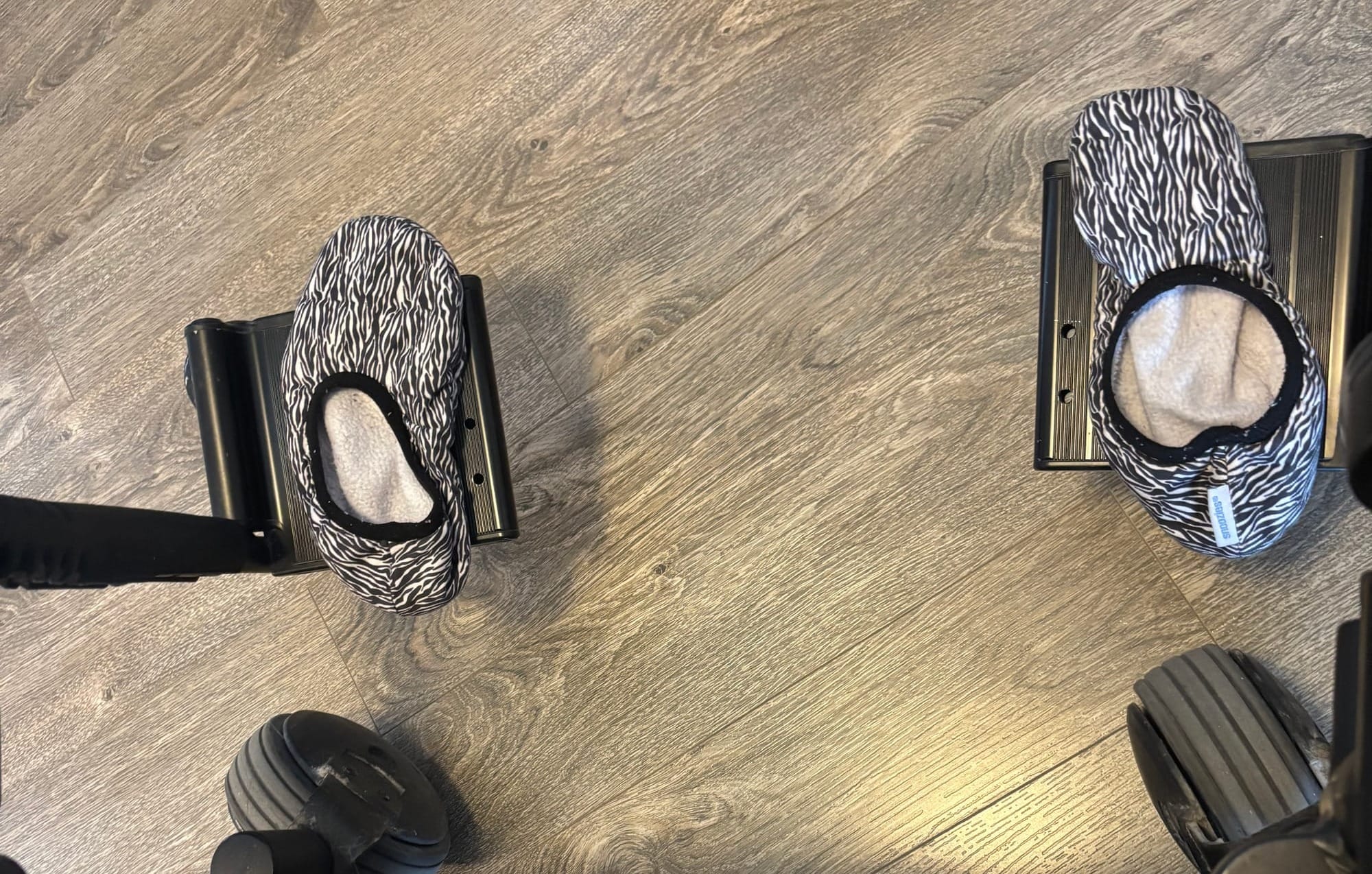
- I am in a wheelchair. My feet (be they bare or not) do not actually touch the bus/ground at any point while I am using the service, as they are suspended above the ground via my footplates.
- Policy wise, when reviewing the Access-a-Bus Registered Users’ Guide there is no direct reference to required footwear or coverings. Only that passengers are required to be fully clothed while travelling. More broadly Halifax Transit as a whole does have this policy in place: All passengers are required to wear: top, bottoms, and footwear. Those failing to meet these requirements will be denied service. I’m not here to debate whether or not "fully clothed" includes footwear, however:
- Also within the Transit Code, the following tenets are stated:

Does then, the transit code only apply to passengers, and not staff? Where is respect one another, be inclusive, be courteous and kind, and honour equality, diversity, and rights for all here? Again, I’m not trying to start a fight. However, when your city is running a service that is specifically designed to assist folks with a variety of access needs, my biggest question is - why was this not approached with more curiosity?
The reality of my situation is:
- I’m an almost full time wheelchair user
- I can’t reach my feet
- I do not have a support person 24/7, nor am I eligible for funding for such
- I am generally independent inside and outside of the home, with this being one of a few limitations I experience.
If I’m being blunt, I’m getting tired of constantly justifying myself and my needs.
In 2024, I took an online Microcertification through Brock University (Ontario) for Accessibility Consulting. We learned about all sorts of policies and procedures that are in place in Ontario and federally to support persons with disabilities. I learned a lot through that — mostly that I still have a ton to learn, but also that Halifax/Nova Scotia do not have nearly the robust policies in place that other Canadian provinces do, which seems misaligned when we consider:
Nova Scotia has the highest proportion of people with disabilities in Canada. According to the 2022 Canadian Survey on Disability:
- 37.9% of Nova Scotians aged 15 and over reported having at least one disability, the highest rate among all provinces and territories.
- This equates to about 301,870 people in Nova Scotia.
- The national average is 27.0%.
- Nova Scotia also leads in the prevalence of most types of disabilities, especially pain-related disabilities (24.9%).
In summary, Nova Scotia not only has the highest percentage but also the highest number of people with disabilities per capita compared to other provinces in Canada.
While precise numbers for Halifax are not available, it would be reasonable to assert that about 30% of Halifax residents live with one or more disabilities, given the above statistics.
I do not speak for all persons with disabilities in Halifax or otherwise, especially because each person’s situations and needs are unique.
I am not writing this blog because I think this specific issue (re: bare feet on Access-a-Bus) will not be resolved or accommodated in some way. I’m certain that it will. I am, however, sharing this to shed light on the reality of day to day life for many people with disabilities.
-We regularly have to endure being asked uncomfortable and personal questions.
-We do face more procedural, attitudinal, and physical barriers than our non-disabled peers.
-Showing up with dignity can feel like a constant fight.
-We don’t want pity. We want those barriers to change.
Back to my bare feet for a second.
I have, prior to this occasion, had bus drivers/other folks ask me “aren’t your feet cold?” Yes. But I can’t reach them. Hard to put something over them if you can’t reach them.
Now. Most folks would go into solution mode at this point.
Appreciate that. Let me save you some trouble.
Well, what about socks/sneakers?
My feet swell often, because of my disability, plus, I was born wide and flat-footed. This made footwear a challenge for me even before I was in a chair full time and could manage footwear. Even then it sometimes took me 10-20 minutes just to get shoes on.
Oh! Have you tried a shoe-horn, this cool thing I saw on Amazon, everything short of hiring a robot butler?
Honestly… yes. But oftentimes those things end in more frustration for me.
Two things: My diagnosis comes with fine motor skills challenges, and dexterity issues (fun, right?) and a (probably TMI but relevant) third thing: My feet don’t physically do that “point” thing that most people can do, so a lot of footwear options don’t work for me.
Well, what *does* work?
Right now, really stretchy slippers or sockettes, but they require another person to put on me because they have to be manually placed around my foot which (at this point) can’t be managed independently with a shoe horn or contraption of any other kind (robot butler yet to be tested).
Okay makes sense, well why don’t you just hire someone, ask someone, or call someone to help you put on your shoes whenever you want to go somewhere?
Listen.
When I first realized that I could no longer deal with my own footwear, I DID do this. I would sit in the apartment lobby with my slippers and wait for a nice looking (as in kind, I’m not trying to flirt) stranger to ask them if they would mind helping me. Most people are nice/kind (or maybe feel obligated), but it’s WEIRD. It’s weird for them, it’s weird for me, it brings up a lot of shame and it’s just not the answer. Some days I’m more willing to humble myself in front of strangers than others. It’s taxing and embarrassing, and dignity? Forget it.
I’ve had gracious roommates and ones I’ve been willing to bribe in the past, but it gets old for both of us, and there’s no possible/feasible way for me to hire someone to be at my beck-and-call when I want to leave my house even if I do have to schedule it a week in advance.
-Exhales-
To Halifax Transit. I’m going to call you and talk about this, and I’m sure we will work something out - but now I have more questions for you.
Why did you not approach this with empathy, or at minimum, curiosity?
It would have gone a long way to include in your message:“We have noticed that…”“Wondering if you could tell us more about…”Or “We’re wondering if there’s an accommodation need that could be met here. Here’s our accommodation process.”
(Is there one?)
If you are someone who can reach their feet, who does not have to think about 6-7 different logistical things before you can leave your house - I would like to know if you would actively choose to leave your house barefoot. I sometimes do - and it's out of necessity.
Given all I’ve laid out, my choices are:
-Have someone help me with footwear (which, when I can, I do, but I do not have full time support in place, as my care needs do not currently necessitate that.)
-Leave my house barefoot (which, when I have no other choice I do)
Or…
-Not leave my house.
Period.
I cringe when I need to go to a public washroom barefoot sometimes. And I do. Because I have to. I’m not doing this because it’s fun or easy. I’m not lazy, it’s not convenient. It’s embarrassing, I feel ashamed about it often, and I haven’t yet figured out a solution that works. I hope you are satisfied that I (and my support systems - family, friends, partner, and professional) have wracked our collective brain to this end.
Perhaps you will say “thank you for the feedback and perspective, you should consider joining our committees”. I have attended Accessibility town halls, joined the Accessibility First Voices (via the NS Accessibility Directorate), and applied for the HRM Accessibility Committee the last time applications were open. I am doing the best I can with the knowledge and capacity I currently possess. Compassion and curiosity could go a long way.
Friends and readers: If you have made it this far, thank you. Thank you for reading. Thank you for taking the time to understand a little bit more about why policy is not (and cannot) be a one size fits all approach. Thank you for considering why Accessible Services are not only necessary but crucial - and that accommodations within the framework of those services are not just about good policy or good character — it’s human rights law.
I will commit to sharing an update (as an addendum) to this post when I have one.
If you are wondering how you can make a difference in local and federal contexts — write to your MPs, MLAs and Halifax City Councillors. Tell them that properly resourcing accessible services, creating, implementing, and upholding Accessibility Policy is a necessity, and that consulting with folks with disabilities and access needs who will be directly affected by these policies is non-negotiable.
We are tired, and we would be grateful for your voice added to ours.
Edited on May 30th to add: I have reached out to Alan and asked to meet or to correspond by email. I'll keep you posted.